


Magic: The Gathering (MTG) Guide: How Cards Work and How to Win
Have you ever heard a game described as “chess, but with dragons and fireballs”? They were almost certainly talking about Magic: The Gathering. You might have seen it played in shows like Stranger Things or heard a friend mention their weekly game night. At its core, it’s a strategy game where two players face off in a wizard’s duel, and every card is a unique piece, from a humble soldier to a world-ending spell. Check out the Best info about riauterdepan.com.
While the game has a reputation for being impossibly complex, that’s a common misconception. According to seasoned players and designers alike, the heart of Magic is built on just a few simple ideas. The entire experience boils down to a single goal: knock your opponent’s life total from twenty down to zero before they can do the same to you. Everything else is just a tool to help you get there.
This beginner’s MTG guide skips the intimidating rulebook to get straight to the action. You will first learn the simple objective that drives every turn of the game. Next, you’ll discover the three main types of tools—the Magic: The Gathering game cards themselves—that you use to summon creatures and cast spells to outsmart your opponent.
Forget trying to memorize a thousand rules. This short tour provides the foundation to understand what Magic: The Gathering is really about. You’ll be able to follow a basic conversation about a match and, more importantly, decide if this legendary wizard’s duel is something you might want to try for yourself.
What’s the Goal? How to Win Your First Wizard Duel
Every great game needs a clear objective, and in Magic, it’s beautifully simple: you’re a wizard trying to win a duel. Your goal isn’t to collect points or reach a finish line, but to knock your opponent out of the fight entirely. You achieve this by methodically reducing their starting life points all the way down to zero.
To track this, each player begins the game with 20 life points. The easiest way to picture this “life total” is as your character’s health bar in a video game. As you take damage from an opponent’s attacks and spells, your life total drops. The first wizard whose life total hits 0 is defeated, and the other claims victory.
Bringing that number down is your constant focus. You can do this in two main ways: by summoning creatures to attack your opponent for you, or by casting powerful spells that deal damage directly—like a magical lightning bolt. This constant back-and-forth of attacking and defending forms the core of the game’s strategy. But to summon those creatures or cast those spells, you’ll first need power.
What Powers Your Spells? Understanding Mana and Lands
So, how do you summon a dragon or cast that lightning bolt we talked about? Just like a car needs fuel, your spells need a special kind of magical energy. In the world of Magic, this energy is called Mana. Think of it as the game’s currency; you can’t play any of your powerful cards without having enough Mana to “pay” for them. Spells can cost one Mana, five, or even more, depending on how mighty they are.
This essential energy doesn’t just appear out of thin air. It comes from the most fundamental card in your deck: the Land. On each of your turns, you can play one Land card from your hand onto the battlefield. These lands represent the territories you control, and they act as your personal resource generators. Each new land you play gives you access to more Mana, allowing you to cast bigger and better spells as the game goes on.
To get the energy from your lands, you perform an action called tapping. This simply means turning the card sideways to show that you’ve used its ability for the turn. Tapping a Land card generates one Mana for you to spend immediately on a spell or creature. Once tapped, a land can’t be used again until your next turn begins, when you’ll get to “untap” all of your cards and use them once more.
Building up your lands turn by turn is the engine that drives your entire strategy. The more lands you have on the battlefield, the more Mana you can generate, and the more impressive your wizardry becomes. Now that you have the fuel, what’s the first thing you’ll want to cast? For most players, it’s a creature to start building an army.
How Do You Attack? Meet Your Army of Creature Cards
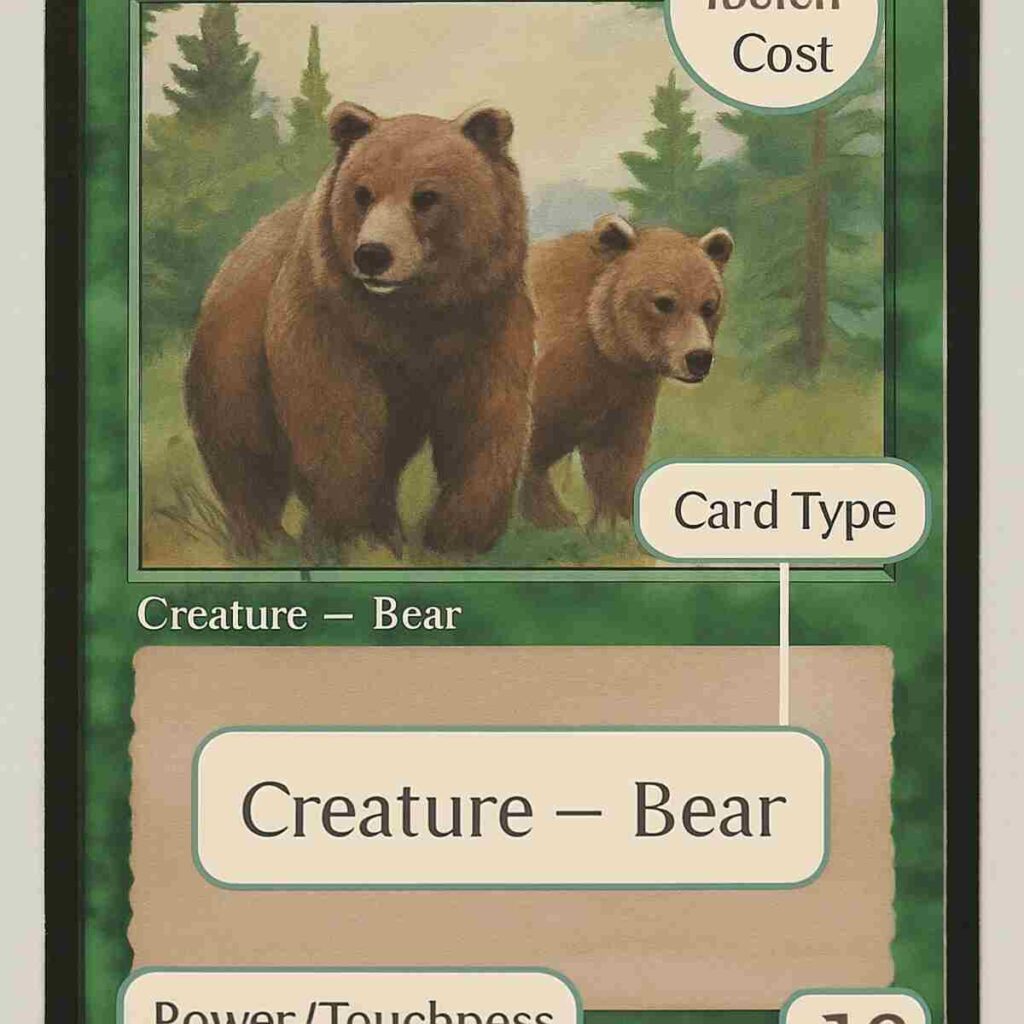
With mana at your command, you can start building an army to fight for you. The most common way to win a game of Magic is by summoning Creature cards. These are your soldiers, beasts, and monsters that stay on the battlefield to attack your opponent turn after turn. A classic example is Grizzly Bears. You can see its mana cost in the top corner—it costs two mana to summon. The middle of the card tells you its type: “Creature.” Once you pay its cost, the bear is on your side, ready for a fight.
The most important part of any creature card is the pair of numbers in the bottom-right corner. For Grizzly Bears, this is “2/2”. Think of this as the creature’s Attack and Health. The first number is its Power, which is how much damage it deals in combat. The second number is its Toughness, or how much damage it can take before it’s defeated and sent away from the battlefield. So, our Grizzly Bears can deal 2 damage and can withstand 2 damage. A creature with high Power is a great attacker, while one with high Toughness is an excellent defender.
So, how do these creatures win you the duel? On your turn, you can declare that one or all of your creatures are attacking your opponent directly. If your opponent can’t block them with their own creatures, that damage is dealt straight to their life total. Sending your 2-Power Grizzly Bears on an undefended attack will knock your opponent’s life from 20 down to 18. Building up a board of creatures is key to victory, but they aren’t the only tools in your spellbook. You also have access to powerful one-time effects that can change the game in an instant.
What Are Spells? Using One-Time Effects with Sorceries and Instants
Beyond your army of creatures, you have access to powerful one-time effects called Spells. While creatures stay on the battlefield to fight turn after turn, spells represent a single, powerful magical act. After you pay the mana cost and the spell’s effect happens—whether it’s destroying an opponent’s creature, drawing you more cards, or healing you—the spell card is used up and put aside. These spells are divided into two main categories based on one crucial difference: timing.
The first type, Sorceries, are your planned, deliberate actions. You can only cast these spells during the main part of your own turn when no other actions are happening. Think of them as setting a strategic plan into motion, like commanding your forces to organize or launching a major offensive. A sorcery might allow you to bring a creature back from defeat or wipe out several of your opponent’s creatures at once, but you can’t use it as a surprise.
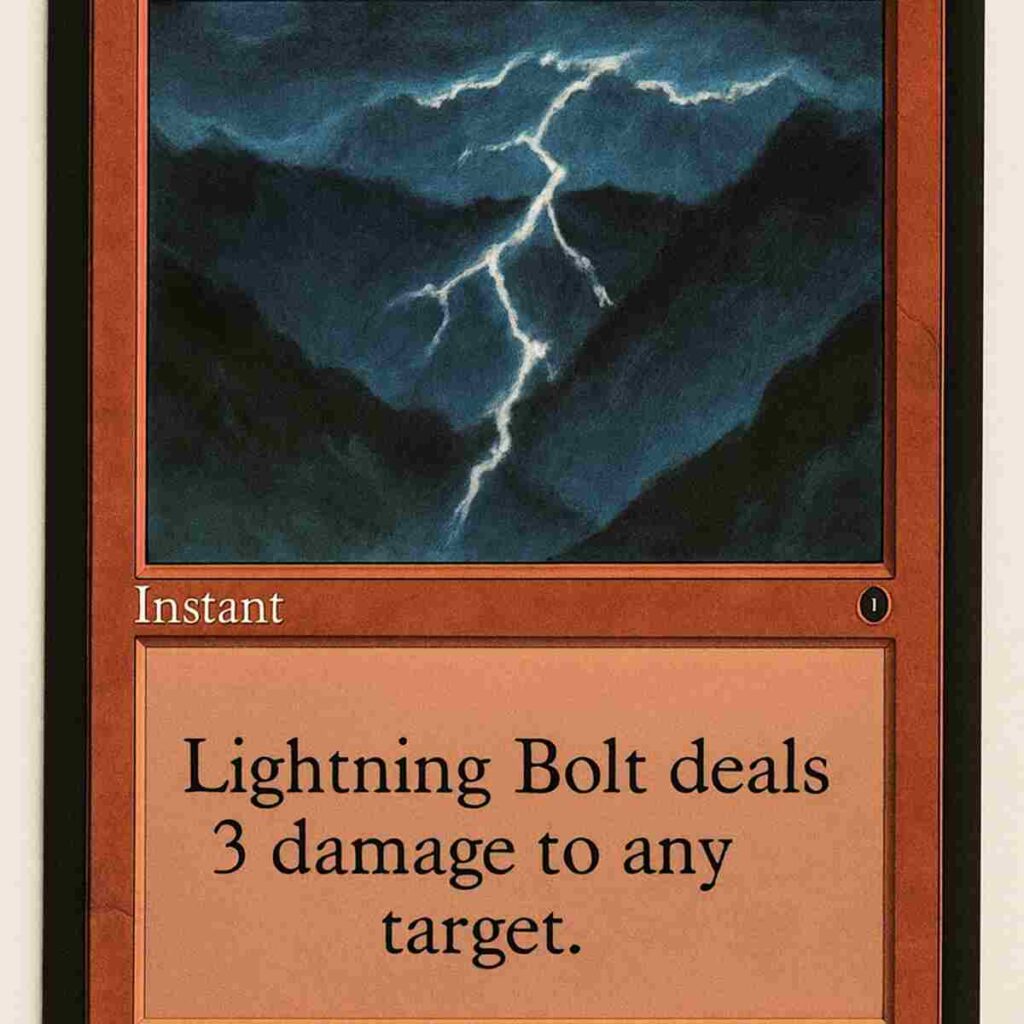
This is where the real fun begins with the second type: Instants. As their name suggests, you can cast these spells almost anytime, even in the middle of your opponent’s turn. An Instant is like a quick reflex or a hidden trap. For example, the famous spell Lightning Bolt is an Instant that costs one red mana to deal 3 damage. If your opponent attacks you with a creature that has 3 or fewer Toughness, you can cast Lightning Bolt at the last second to destroy it before it can even touch you.
This difference between planning a move with a Sorcery and reacting with an Instant is a huge part of what makes Magic: The Gathering so strategic. Knowing not just what card to play, but exactly when to play it can turn the tide of the entire duel.
Your First Turn: A Simple Step-by-Step Walkthrough
Now that you have an arsenal of lands, creatures, and spells, how do you actually put them to use? The answer lies in the turn, the basic rhythm of the game. Forget about complex rules and phases; the core of an MTG turn order can be broken down into three simple, memorable steps. These magic card game basics are the engine that drives every duel. Every turn you take follows the same reliable pattern:
- Ready your resources. This is called the “Untap Step.” You simply turn all of your tapped (sideways) cards back upright. This makes them available to use again, like recharging your batteries for the turn.
- Draw one new card. You take the top card of your deck and add it to your hand, giving you a new option.
- Take your actions. This is where you make your big plays. On your turn, you are allowed to play one Land card from your hand. You can also cast spells, like creatures, as long as you have enough untapped lands to pay their mana cost.
This simple loop feels very natural in practice. Imagine you played a Forest land on your first turn. On your second turn, you would first untap that Forest. Then, you’d draw a new card. During your action step, you could play a second Forest from your hand. Now you have two untapped Forests on the battlefield, which means you have two green mana available. You can tap both of them to cast a creature like Grizzly Bears, which costs two mana. With that, you’ve built your board, and your turn is over. This simple rhythm of readying, drawing, and playing is the foundation of every game.
What Kind of Wizard Are You? A Quick Guide to the 5 Colors of Magic
Beyond the basic rules, the real soul of Magic comes from its five distinct colors. Think of them not just as colors, but as five different philosophies or personalities a wizard can adopt. Each of the five colors of magic has its own unique strategy, strengths, and weaknesses. Choosing your colors is the first step in deciding what kind of player you want to be.
On one side of the spectrum, you have White, the color of order, protection, and community. A White mage builds disciplined armies and defends them with healing spells, aiming to create a just and unified force. Its philosophical opposite, Blue, is the color of intellect, deception, and control. Blue mages love to outsmart their opponents, using illusions and countering spells to control the flow of the game.
Conversely, Black embraces ambition and the pursuit of power at any cost. This color uses forbidden magic to raise the dead, sacrifice its own resources for a greater advantage, and drain life directly from its foes. Then there’s Red, the embodiment of chaos, impulse, and aggression. Red mages use fire and lightning to deal direct damage and summon fast, reckless creatures to overwhelm opponents before they can mount a defense.
Finally, Green represents the raw, untamed power of nature. This color is all about growth, instinct, and brute force, summoning the biggest and most ferocious creatures in the game to simply stomp over the competition. While understanding each color is crucial, the true creativity shines when you combine them. A Red/Green deck might focus on aggressive beasts, while a White/Blue deck could be a controlling, tactical force.
Your choice of colors defines your deck’s entire personality and how you approach a duel. This fundamental concept, which players often refer to as the color pie, is the perfect starting point for discovering a playstyle that feels right for you. Luckily, you don’t have to build a deck from scratch to find out which one you prefer.
How Can I Actually Try Playing? Your Guide to Starter Decks
Now that you know about the five colors, the idea of building a deck from thousands of different cards might seem overwhelming. The good news is, you don’t have to. The easiest way to start playing Magic: The Gathering is with a pre-constructed deck. Think of it like buying a complete board game instead of trying to invent your own from scratch. These products give you a balanced, ready-to-play experience right out of the box.
For anyone just starting, the single best purchase you can make is an official MTG Starter Kit. These boxes are a fantastic value because they are specifically designed for two people to learn together. Inside, you’ll find two complete, 60-card decks that are balanced to play against one another. This means you and a friend can open the box, pick a deck, and start your first game in minutes, making them the best starter decks for new players by a wide margin.
As you play, you’ll get a feel for how different color combinations work and discover which style you enjoy most. But while exploring these decks, you might begin to wonder what separates these straightforward cards from the rare and powerful ones players talk about. Why is one card common, and another worth a small fortune?
Why Is One Card Worth $1 and Another $1,000? Understanding Rarity
That question of a card’s value is central to the “collectible” part of this card game. Unlike a standard deck of playing cards, Magic cards are primarily sold in Booster Packs—small, sealed packs containing a random assortment of about 15 cards. The thrill comes from not knowing what you’ll find inside, because not all cards are created equal. They are intentionally printed in different quantities, a system known as rarity.
You can instantly tell a card’s rarity by looking at the small symbol located in the middle of the card, just below the art. Understanding Magic card rarity symbols is easy, as the color of this symbol tells you everything you need to know:
- Black: Common (The most basic cards, you’ll get several in every pack.)
- Silver: Uncommon (Slightly more complex or specialized.)
- Gold: Rare (Often powerful, game-changing cards. You typically get one per pack.)
- Red-Orange: Mythic Rare (The absolute most powerful Magic: The Gathering cards or iconic characters, appearing in only about one in every eight packs.)
This system of scarcity directly influences a card’s desirability. Because a Mythic Rare card is so much harder to find than a Common, it’s naturally more sought after by players who want its powerful effect. This scarcity, combined with how good the card is in the game, is the simple formula that helps determine MTG card value. A powerful, hard-to-find card will always be in higher demand.
So while you won’t be pulling a thousand-dollar card from every other pack, the possibility is always there. This excitement of discovery is a huge part of the fun. And when you do find that special gold or red-orange symbol, you’ll want to make sure it stays in perfect condition.
How to Protect Your Cards: A Simple Guide to Sleeves and Storage
Now that you know some cards can be quite valuable, the idea of shuffling them together and sliding them across a table might sound a little scary. This is why the single most important accessories you can buy are Card Sleeves. Think of them as durable, clear-fronted phone cases for your cards. They protect against scratches, spills, and the general wear-and-tear of gameplay. For anyone who plans to actually play with their cards, sleeves are non-negotiable. The best card sleeves for MTG often come from trusted brands like Dragon Shield or Ultra Pro.
Once your deck is sleeved, you’ll notice it’s thicker and won’t fit in the original packaging. The next logical step is a Deck Box. This is simply a sturdy case, usually made of plastic, designed specifically for holding a sleeved deck of about 60 to 100 cards. A good MTG deck box makes carrying your cards to a friend’s house easy and prevents them from getting bent or lost in a backpack. It’s an essential part of protecting and storing your card collection.
With your valuable cards safely tucked into sleeves and stored in a deck box, you’re not just a collector anymore—you’re a player ready for a game. These simple tools ensure your investment and your favorite cards last for years, ready for countless duels.
You Now Understand Magic: What’s Next on Your Journey?
Congratulations! What was once a confusing game is now a battlefield you can navigate. You know the goal is to get your opponent from 20 to 0 life, the engine is using lands for mana, and the tools are your creatures and spells. With this foundation, you’re prepared to learn more and take the next step.
Wondering how to start playing? The easiest first step is digital. The game MTG Arena is perfect for beginners, with free tutorials that let you practice at your own pace and build confidence without any pressure.
If you’re looking for where to play in person, visit a local game store. Just ask about “Welcome Decks” or starter events—they are designed specifically to help new players feel comfortable and find their first opponents.
You can also grab a two-player “Starter Kit” and teach a friend yourself. Those cards are no longer just text and art; they are the beginning of your own wizard’s duel, waiting for you to tell the story.