


Just opened the box for the In a Pickle card game and feeling a little… well, in a pickle? Don’t worry. While the concept of this Gamewright classic might seem unusual at first, its rules are incredibly simple. This guide will make you the table expert in under five minutes by showing you the one core idea that makes the entire game click into place. Check out mpbsnacks.com to know more
At its heart, the game is as simple as a set of Russian nesting dolls, but with words. The entire challenge revolves around a single question: does this thing fit inside that thing? You’ll constantly be trying to play a Noun card from your hand that can be contained within the card already on the table, creating a chain of smaller and smaller items.
This simple premise is what makes the game so much fun, sparking wonderfully silly debates. Can a secret fit in a diary? Can a planet fit in a dream? Can a goldfish fit in a glove compartment? In this game, you and your friends get to argue your case and vote on the answer, which is where the real laughter begins. You’re about to master how to play the In a Pickle game and be ready for your first round.
What’s in the Box? Understanding Your Cards and the Goal of the Game
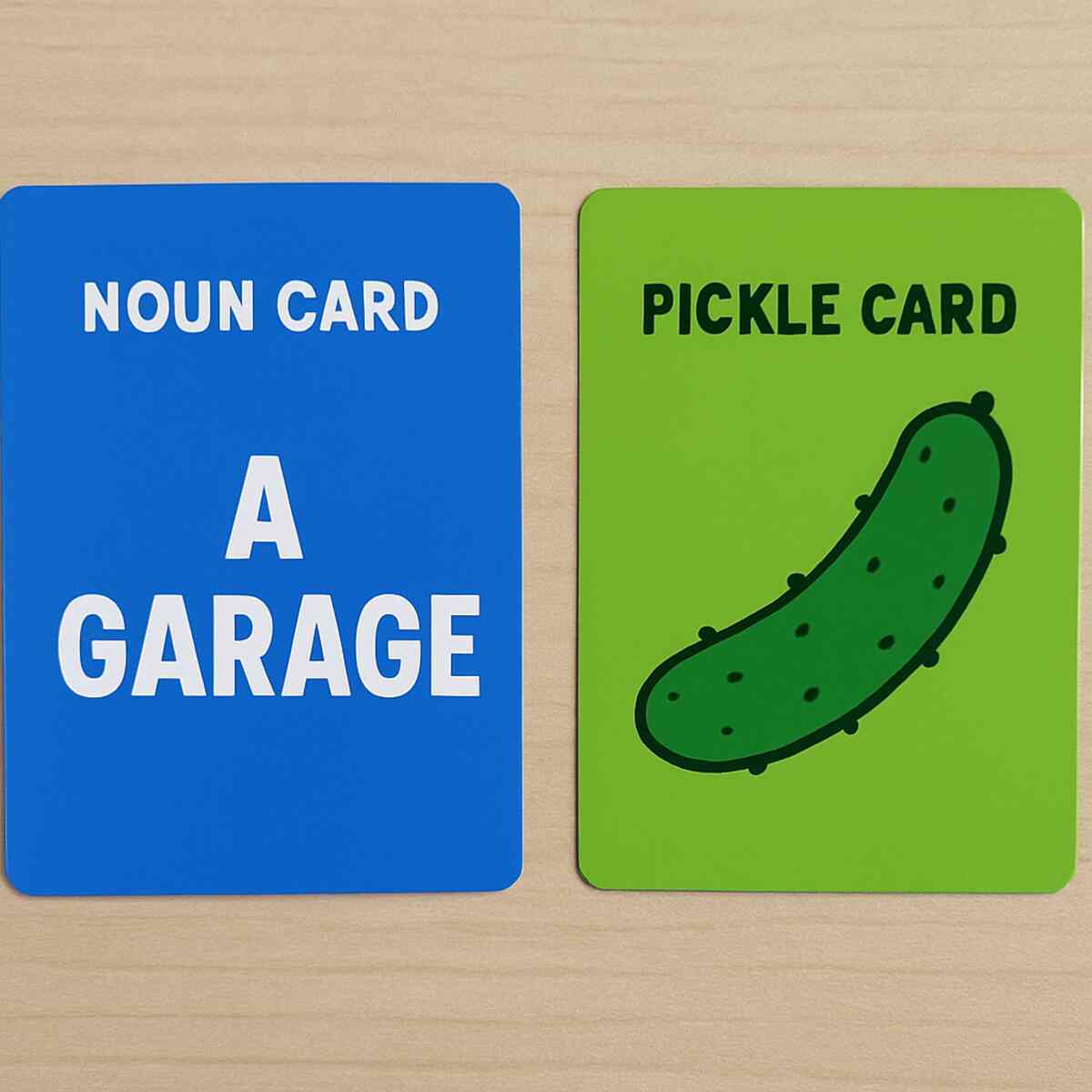
Inside the box, you’ll find two main types of cards that are key to the game’s instructions. The vast majority are blue Noun Cards, which feature all sorts of “things”—from ‘A CAR’ to ‘A CONVERSATION’. You will also have a few green Pickle Cards. Think of these as your secret weapon; they’re special cards that let you reset the game when you’re stuck, giving you a fresh start.
Now, for the quirky part: don’t put the game box away! Turn it over and you’ll see the phrase “The Fourth Dimension” printed on it. This isn’t just decoration; the box itself is the starting point for every round. It represents the largest possible container you can imagine, the ultimate “place” where everything begins.
The object of In a Pickle is wonderfully simple: be the first person to play all the cards from your hand. You achieve this by cleverly placing your Noun Cards one after another, creating a chain where each new card logically fits inside the one played before it. The first player with an empty hand wins the round and proves they are the champion of creative thinking.
How to Set Up Your First Game in Under 2 Minutes
Ready to play? Getting the game from the box to the table is incredibly quick. Just follow these four simple steps, and you’ll be ready to start your first round.
First, gather up all the blue Noun Cards and green Pickle Cards and give them a good shuffle together to create one main deck. Then, follow this easy setup:
- Deal five cards, face down, to each player. You can look at your hand, but keep it a secret from everyone else!
- Place the rest of the cards in a single stack face down in the middle of the table. This becomes the Draw Pile, where you’ll grab new cards during the game.
- Take the now-empty game box and place it nearby, making sure the side reading “The Fourth Dimension” is facing up.
That’s it—you’re all set up! That game box is the official starting point for the first stack of cards, which is called a Set. Since the game humorously suggests that everything fits inside “The Fourth Dimension,” it serves as the base for the very first card played.
How to Take Your Turn: The Core “Fits Inside” Rule Explained
Now for the fun part! The goal on your turn is simple: play one Noun card from your hand on top of the last card played in a Set. The golden rule of the game is that your card must fit inside the card it’s being played on. Think of it like a set of Russian nesting dolls, but with words. The player to the left of the dealer starts by playing a card on the “Fourth Dimension” box, and the game is on!
For instance, the first player could start a Set by playing ‘A UNIVERSE’ on the game box. The next player could then look at their hand and play ‘A GALAXY,’ since a galaxy fits inside a universe. Following that, another player might add ‘A PLANET’ on top of the galaxy. With each turn, the Set of cards gets smaller and more specific.
These connections don’t just have to be physical. While an obvious play is ‘A CAR’ on top of ‘A GARAGE,’ the real fun begins with creative and conceptual plays. A ‘SECRET’ can easily fit inside ‘A DIARY,’ and ‘A THOUGHT’ certainly fits inside ‘A MIND.’ As long as you can make a case for it, your play is potentially valid—which is where the game’s hilarious debates come from.
But what happens when you look at your hand and realize nothing you’re holding fits the card in play? If the card on the table is ‘A POCKET,’ you can’t exactly play ‘AN OCEAN.’ When you find yourself in this situation, you have a specific action to take instead of playing a card.
Stuck? What to Do When You Can’t Play a Card
It’s bound to happen: you’ll look at your hand, then at the card on the table, and realize none of your nouns fit. Don’t worry! This is a core part of the experience. If you cannot make a valid play on your turn, you simply announce that you can’t play. The only “penalty” is that you must draw one card from the deck, and your turn is over.
This isn’t a major setback; it’s a normal part of the game’s flow. Understanding these basic instructions is key to a smooth first game. Drawing a card might feel like you’re moving further from the goal, but it also gives you more options for future rounds. After you draw, play simply continues with the person to your left, who will attempt to play on that same tricky card.
So, your standard choice when stuck is to take a card and wait for your next turn. But what if you wanted to completely change the game and start a whole new Set of cards from scratch? Luckily, the game gives you a powerful tool to do just that.
How to Use a “Pickle Card” to Escape a Tight Spot
That special tool is the green “Pickle Card.” Sprinkled throughout the deck, these cards are your ultimate escape hatch. Instead of playing a Noun card on your turn, you can choose to play a Pickle Card right on top of the current Set. This move instantly changes the game and gives you a powerful advantage when you’re in a tough spot. Think of it as hitting the reset button for the entire table.
When you play a Pickle Card, its first job is to end the current pile of cards. You simply take the entire Set—from the first card played to the one right under your Pickle Card—and place it in a discard pile. That tricky card everyone was stuck on, like “A NEEDLE’S EYE,” is now gone for good. This is a core mechanic of the game and your best way to clear a Set that has become too specific.
After discarding the old pile, the Pickle Card’s second job kicks in: you get to start a brand new Set. With a clean slate, you now have the freedom to play any Noun card from your hand to begin the next Set. It could be something huge like “A GALAXY” or something tiny like “AN ATOM.” This move gives you total control, allowing you to choose a word that works best for the cards you’re holding.
So, the Pickle Card offers you a strategic choice. You can play it when you are genuinely stuck, or you can play it proactively to get rid of a Set you don’t like. This element of control makes the game more than just a simple word association game. But while the Pickle Card gives you power, the most hilarious moments come when another player makes a questionable move. That’s when you challenge them.
The Fun Part: How to Challenge a Play and Let the Group Decide
Sooner or later, it’s going to happen. A player will confidently place a card on the pile that makes you tilt your head and think, “Wait a minute… does that really fit?” This is where the game’s creative chaos truly shines. Unlike other word association card games where the connections are straightforward, this game encourages debate. When you think a play is impossible, you can officially challenge it.
If a play seems too far-fetched, you simply announce, “I challenge that!” before the next person takes their turn. The game immediately pauses. The player who made the questionable play now has to defend their logic to the rest of the group, while the challenger can offer a counter-argument. This simple declaration turns the game from a quiet card-laying activity into a hilarious courtroom drama.
Once a challenge is declared, the process is simple and democratic. The fate of the play is put to a group vote.
- The Play: Your friend plays ‘A SECRET’ on ‘A BOTTLE’.
- The Challenge: You declare, “I challenge that!”
- The Justification & Vote: Your friend argues, “You can ‘bottle up’ a secret!” The rest of the players (everyone except the two of you) vote with a thumbs-up for a valid play or a thumbs-down for an invalid one.
- The Outcome: If the vote passes (majority thumbs-up), the play is good! The challenger (you) must draw two penalty cards. If the vote fails, the play is rejected, and the player who made it must draw two cards.
These debates are what make this one of the most funny card games for families. The goal isn’t to be strict but to see who can come up with the most clever—or ridiculous—justification. Can fear fit inside a shadow? Can a tune fit inside a memory? It’s up to your group to decide, making every game a unique experience.
How to Win a Round and Claim Victory
You’ve learned how to play, how to challenge, and how to use every card. So, how do you win? The immediate goal is straightforward: be the first player to successfully play the last card from your hand. The moment you empty your hand by making a valid play, you have won the current round. All the debating and creative thinking pays off in this single, satisfying moment.
Winning the round isn’t just for bragging rights; it’s the only way to earn points. As your reward for going out, you collect the entire pile of cards—the “Set”—that you just finished. Place this stack of cards face down in front of you. This completed Set counts as one point. The scoring is that simple: one completed Set equals one point.
After a player wins a round and collects their Set, the game continues. Everyone else discards their hands, and the dealer gives each player a new hand of five cards. A new round begins, building on a fresh “Fourth Dimension” card. The game ends when one player has successfully collected a predetermined number of Sets (the rulebook suggests four, but you can agree on any number). That player is the grand champion!
Special Cases: How to Play with 2 Players and Break a Tie
While the game truly shines with a crowd, the rules for two players make for a fantastic head-to-head duel. The main change comes during a challenge. Since there’s no group to vote on a play’s validity, the power shifts entirely to the challenger. When you challenge your opponent, they still get to argue their case, but you become the sole judge. If you decide their play isn’t valid, they lose the challenge and draw two cards. If you accept their logic, however, you’re the one drawing cards.
What happens if two or more players reach the winning score at the same time? The official tiebreaker is designed for maximum drama: you play one final, winner-take-all round. All tied players participate. Discard your old hands, deal a fresh five cards, and start a new Set from the box. The first person to empty their hand in this single, high-stakes round is crowned the ultimate champion.
With these simple adjustments, you’re ready to handle any situation, making it a perfect card game for families of any size. The core fun—arguing whether “a feeling” can fit inside “a song”—remains the same.
In a Pickle vs. Apples to Apples: What’s the Difference?
If that comparison to Apples to Apples caught your eye, you’re onto something—both are fantastic word association card games that rely on players making a case for their card. The core difference, however, lies in who you’re trying to convince and what you’re trying to prove. In Apples to Apples, your goal is to appeal to one person’s sense of humor or personal taste. In contrast, In a Pickle challenges you to defend your play with creative, and often hilarious, logic in front of the whole group.
The best way to see the difference is to look at how they work side-by-side. While they are both great party games, their mechanics create very different experiences.
- Judging: In a Pickle uses a group vote to decide if a play is logically sound, while Apples to Apples uses a single, rotating judge who picks their subjective favorite.
- Goal: The aim in In a Pickle is logical nesting—proving your card fits inside the last one. In Apples to Apples, the goal is to best match a descriptive theme card.
- Core Action: In a Pickle involves players building on a single, continuous pile. Apples to Apples has everyone play a card simultaneously for the judge to review.
Ultimately, your choice depends on the kind of fun your group is looking for. If you love a fast-paced game with a rotating “king of the round” and subjective humor, Apples to Apples is a classic. But if your group enjoys spirited debates and bending logic to its breaking point, you’ll find that In a Pickle offers a uniquely satisfying challenge.
You’re Ready to Play! A 30-Second Recap for Your Game Night
Congratulations! You’re no longer in a pickle about the rules. Just a few minutes ago, this game of creative comparisons was a mystery; now, you have everything you need to confidently lead your first round. To make it even easier, use this quick reference sheet during play.
Your Game-Time Cheat Sheet:
- GOAL: Be the first to play all cards from your hand.
- PLAY: Play a card that fits INSIDE the card on the pile.
- CAN’T PLAY?: Draw 1 card. Your turn ends.
- CHALLENGE: Disagree with a play? Let the group vote! Loser draws 2 cards.
- WINNING: First player with no cards wins the round and takes the pile as 1 point.
While you now know how to win, remember that the best moments aren’t found in any instructions. The real victory is sparking a two-minute debate over whether “a secret” can fit inside “a sandwich.” Embrace the creativity, enjoy the arguments, and have a great game.
